It’s been over two calendar months since I last posted, and 11 months since I started this project. The time has come to put a more permanent pause on this journal.
I began to really get on my own case over my lack of posting lately, and for the handful of people that subscribe to this blog I feel as if a brief update is owed. For the people that have randomly come across this blog to help them through their own journey, or understand a loved one going through it, I hope that this epilogue is the last post you’re reading and the year is 2030– that means I’ve been cured and there has been nothing notable to report in the meantime!
A quick list of health updates:
I still see BH every 3-4 weeks. Understanding the connective tissue that remains between my old life, my experience with cancer, and my new life has been important to moving forward emotionally. I recommend it.
I’m seeing cognitive therapy about once a week and physical rehab three times per week. Cognitive function is a hard thing to measure if you don’t have a baseline, but I think on the whole it’s a net positive. At the very least it’s another person involved in monitoring my recovery. Strength training has benefited me greatly at physical rehab; I’m back in the 170s and am hoping for 180s by the time I reach my one year post-treatment mark in May.
My second quarterly PET went without issue in early December. The ENT got a little worked up over some blurriness in the areas of greatest concern, but it was chalked up to a swallow or something at the moment the scan was taken. My lymph nodes continue to shrink and my throat continues to show improved tissue quality.
My fatigue and stamina has improved a lot, but I’m still not my old self. It’s a work in progress but I’ve become a little less dependent on coffee. I think that’s going to be the longest of long-term recovery projects, if other experiences I’ve read on the internet are any indication.
Saliva is improving at a glacial pace, but it is improving, right alongside my taste buds returning. Spicy is the last hold out, but I’ve made significant progress on that front in large part due to Sarah’s insistence that I continually try new things.
I got sick for the first time this week! A common cold! I’m really proud of how well my body and mind handled it. I wasn’t a complete vegetable and even managed to function as a normal person with the assistance of some off-brand cold meds and honey. My sleep suffered, but I’m hoping it returns to normal soon.
============
I’m not going to provide any work, parenting, or relationship updates. Those are wholly subsidiaries of my life going forward and largely independent of my recovery (with occasional exceptions). But safe to say I’m marching in the correct direction (at the time of this publishing) on all three fronts.
============
If you’re reading this because you were just diagnosed, undergoing treatment, or just looking for corroboration or validation of some of the things you are feeling in your own cancer journey, my sincerest condolences and prayers go out to you and your loved ones.
It sucks.
It’s hard.
It’s going to challenge you in ways you never imagined.
It’s going to change you forever.
It’s ok to have some hope, trust God, and listen to your doctors. Some people fare better than me– in fact I’m sure many do. No one person handles it exactly the same as the next; no matter what you are feeling: it’s ok to feel that way.
I once quoted The Martian “I’m not going to die here” in my announcement of my diagnosis to my friends and family, so this feels like the appropriate bookend to end this with.
-CPT Cancer, 4 JAN 2026
The views and opinions presented herein are those of the author and do not necessarily represent the views of the Department of Defense or the U.S. Army.
Just as soon as my mom’s husband was here, he was gone back to Florida. He’d done everything he could for me here, and lifted my moms spirits no doubt but we couldn’t smash us three plus the occasional pair of kids in my 850 square foot cottage forever.
Every week is a new adventure in my life ever since I was very first seen about the lump on my neck, and I’d thought that would slow down with recovery and every day would start to blend together into more of a groundhog day where the only noticeable difference is I regain some function or capability, or at least a portion of it progressively. That’s still happening in a sense, but the world keeps spinning whether I’m trying to spin with it or not, and I don’t live in a bubble.
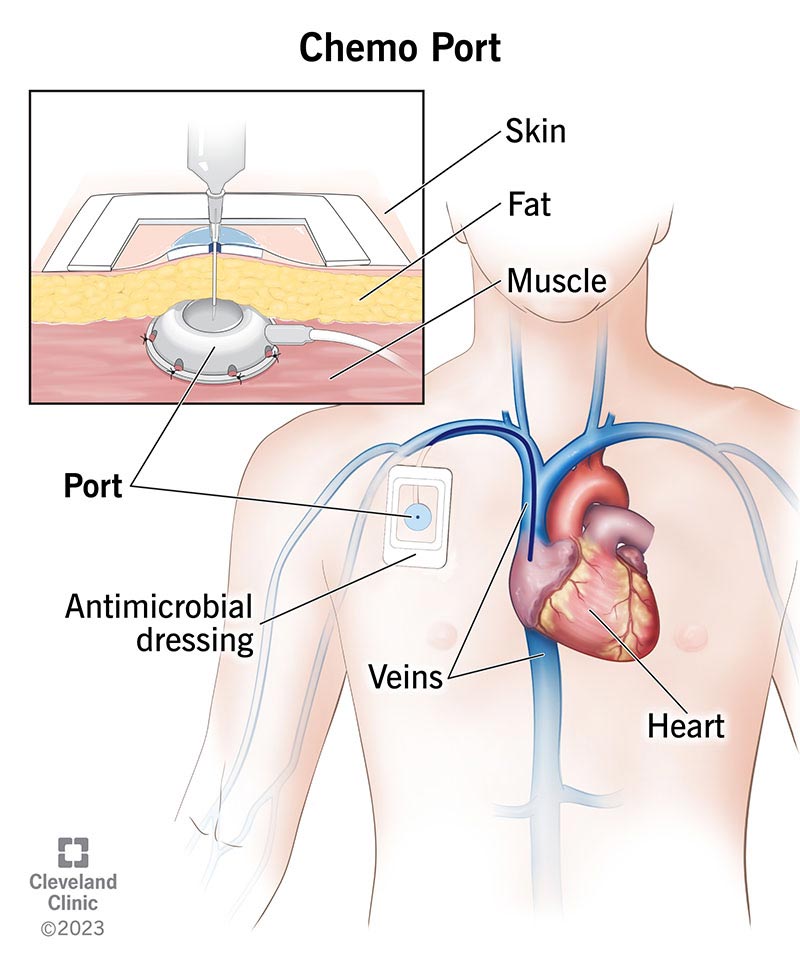
This was the first week I allowed the infusion clinic to keep my chest port accessed throughout the week, versus the usual procedure of getting it accessed and de-accessed daily. What this means is I let them keep the needle inside the port with a small tube hanging out, kept on and secured by some adhesive strips and squares. I kept it accessed Monday through Friday, since my hydration appointments are daily, and it was overall less painful for me and easier for the nurses at the infusion clinic. I took a shower with it on, which was a little nerve-inducing, but nothing went haywire.
For the uninitiated, having a port in your chest basically means I have a small plastic hose that runs from a vein near my heart to a type of, well, port that is just underneath your skin. Back in mid-February when I had it put in it was barely perceptible, at a glance, aside from the slight bruising and discoloration, and now that I’ve lost 35 pounds it protrudes fairly noticeably when I take my shirt off. The purpose of the port is to have an easy access point pre-drilled into your circulatory system for things like chemo, which takes hours of being hooked up to an IV, scheduled hydration, and hospitalization. Instead of slipping a line into your arm, they can take a special port needle and tap right into your system from your upper chest.
Image courtesy of the Cleveland Clinic, which, by the way, has an excellent public library of online health topics.
Like I said above, no two weeks are the same anymore, but I do find myself settling into a mental lull as I grind through this period of “recovery.” The damning thing is that I don’t even know if I’m in recovery from cancer, recovery from treatment, or both. I’m definitely in recovery from treatment, that much is obvious even with the painstakingly slow rate in which that’s being achieved, but I don’t know if I’m cancer free yet and that hangs over me like barely-perceptible anvil head clouds somewhere on the horizon. Is it there? Is it going to hit me? Will it swing away? Is it even there at all?
============
My speech had really started to normalize during week four of recovery. I no longer really felt the need to hold back, keep my mouth artificially closed, or avoid certain tones. This was important for me to sound more like myself again, but maintaining conversations over a sustained period of time is difficult because of my dry mouth. It will take up to a year or longer for me to regain most of my salivary glad capabilities, which means I run out of steam quickly when having “long form” conversations, and I worry tremendously for what this means when I am able to begin exercising again. Water brings temporary relief, but I still have to self-regulate in this regard. Keeping my mouth shut, not exerting myself for a few minutes at a time, and trying to use medicated aids are the only real allies in that small battle in this larger war.
The idea that I’m “exerting myself” brings a grin to my face even as I type it. I have basically no muscle mass left. During week four the most I could do was walk from the car into the hospital and to whatever clinic I was heading to at the beginning, but by Sunday evening I was able to mow my entire front and back lawn. Now, this is basically just walking the same distance as I would be from parking lots into hospitals and clinics, but outdoors and pushing a small electric motor- no small feat when you consider where I was a month ago. The downside to doing an activity like this however, is I’m completely worthless the rest of the day. Anything other than “sit in the recliner and rest” exacts a massive toll. What was, pre-cancer, an embarrassment of riches when it came to stamina, is now a near-bankruptcy. My body lives paycheck to paycheck when it comes to energy levels. Any time I challenge it I have to pay in back ten times over.
Another wrinkle of this recovery period, however, is the inability to rest how I need. My ability to sleep has taken a hit. I can be incredibly tired, physically, mentally, emotionally, and even medications I’ve been taking that are known to help induce sleep do not even make a dent. About half the week, despite being completely exhausted, I was only able to get a few hours of restful sleep. This is not what progress looks like to me, but unless it continues I’ll chalk it up to a small bit of choppy water hitting the boat.
============
You’ll notice that this blog is being cut loose on a Friday of what would be “week 5” of recovery. This is obviously part of a pattern where the entries are slipping further and further “off schedule” of zero to three days after the preceding week I’ve been trying to keep for the core group of family and friends that manage to work their way through this blog to stay updated on my health. I have a lot to say, believe me, about this process and the health and non-health related wrinkles during this adventure, but I don’t think I will be attempting to remain “on schedule” anymore. I will still be making regular entries, but they won’t be driven as a weekly update format, but more event or need/news based update. There’s apparently the ability to subscribe to updates via email, if you aren’t keen on checking my FB/IG story to see when these float in.
============
The views and opinions presented herein are those of the author and do not necessarily represent the views of the Department of Defense or the U.S. Army.
When you ring the bell at your final cancer treatment there is no magical test they administer to tell you that you are cancer free, in fact, all of your doctors will certainly tell you you are not cancer free… but you will be.
See, radiation and chemotherapy are cumulative treatments. This means that as you continue to do them they continue to build up in your body to keep your cancer first in check, then kill it, and keep it from reproducing. The effects of these treatments are meant to outlive the length of the treatment by design. So, for about the next 90 days I’ll have chemo and radiation in my body doing battle against what remains of the cancer cells in my body. In three months I’ll get the first of my quarterly PET scans to see if there is any remaining cancer but my medical oncologist, Dr. Ferrell, warned me that the site will likely be too active with toxicity to be conclusive. My 6-12 month scans will be the ones that tell the tale accurately.
A clean scan means there’s, ostensibly, no more cancer left in my body. A scan could also reveal it spread at some point and I need a new treatment to address it, or that it isn’t all gone in the original site and we need to figure out a new plan to kill the rest of it. Both, as you might imagine, are not the outcomes I’m looking for but it’s not really in my hands.
As I alluded to in my last post, while it was a very touching moment when I got to ring the bell at the proton center, it was actually the beginning of a hellish week for me. I was warned that recovery would start off with two terrible weeks before I started to notice actual recovery and improvement but good lord.
============
Hydration
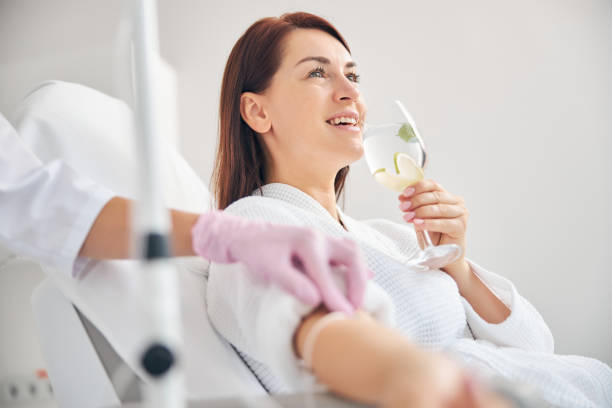
As I’ve mentioned before, I receive regular “hydration” infusions that have increased in frequency to the point where I have it done daily at the Army hospital now. Every day for the next few weeks I’m scheduled to go in for an hour and get an IV of standard sodium chloride fluids to help stave off dehydration until I can get enough fluids in on my own either through my feeding tube or orally.
At first my hydration appointments were an amalgamation of times at the cancer center in Seattle and the oncology department at the Army hospital, but finally I was able to get into the outpatient infusion services at the Army hospital where they have the capacity to accommodate someone like me that needs daily treatments.
Average IV infusion experience at an Army hospital.
Over the weekend I had the feeling I was going to be in trouble, as my nausea was to the point where I didn’t want anything through my tube and even medicines were off the table to include nausea and pain meds, because they inevitably made me vomit. In the back of my mind I figured if I could just make it to Monday’s hydration appointment I’d feel right as rain afterward. I was wrong. I didn’t feel better at all.
I was now finally caving to the idea that I might have to go to the dreaded ER to wither and die in triage while they figured out what to do with me. My mom had been on the phone with my oncology case manager and the wheels began to turn to get me admitted for at least a night to get me back on track.
The next day, Tuesday, I felt half dead. My mother wheeled me into the infusion clinic and I had to lay on the floor just to avoid falling out of the chair. I received my infusion but was shuffled into a private room after to wait. I saw Dr. Ferrell and we had the discussion that if I had to go to the ER I’d rather just go home because I had zero faith the ER was going to be good for me. He tended to agree given the ER’s trust level in that facility, and was working a deal to get me into the inpatient floor for family medicine. I was tired, in a bad mood, and felt terrible. All winning combinations to make great decisions with.
The family medicine team came to see me and I was not kind to them. I didn’t understand what they were going to do for me that was different that what I was doing for myself, or could do for myself, at home. I waived them off and wanted to speak to Dr. Ferrell again. Someone needed to tell me what the hell was going to happen in a way that made sense to me or I was just going home. I wasn’t going to go resign myself to a night of misery in the ER, or have another night like I did when I got my feeding tube placed, as a revolving door of medical pros just trying to make it through their shift acted like they gave a shit about me for 12 hours until they could wash their hands of me and go pound beers at MacNameras.
Dr. Ferrell, visibly annoyed by my resistance, came back and was able to satisfactorily explain everything I needed to understand and my concerns. Ok, fine, I’ll go. But if this sucks for no reason I won’t trust any of you ever again.
============
The Resurrection
I was wheeled up to the family medicine floor of the hospital and taken to a private room, thank God for being immunocompromised, where I was laid in bed and hooked up to a new IV and weighed. 170. Holy shit. That’s 15 pounds lost in less than six days. I haven’t weighed that much at my current height since I was 19 years old. This, as you might imagine, freaked me out a little bit. Not the lightest I’ve ever been at this height, but close enough. I have my work cut out for me during this recovery.
Throughout my stay at family medicine I was blessed in the sense that the daytime attending doctor remained the same the three days I ended up being there, and 80% of the nurses were excellent. The remaining 20% I’d classify as “good enough to keep me alive.” I was continually fed IVs and eventually feeding through my tube was reintroduced at a crawl, but increased gradually through my stay. My nausea meds were reintroduced through my IV and overall I began to feel better by about one percent per hour. Over the course of 72 hours my gains were significant. By the time I was discharged Thursday afternoon I was feeling optimistic that I could carry on at home and do enough to survive this awful phase of recovery.
Through the rest of the week to today, Sunday, I’ve managed to remain fairly steady in my feeding regimen, increasing the pump rate slowly, and I’m hoping to break 100 ml/hour later this morning.
============
Mother’s Day
Today is Mother’s Day in the USA (I have no idea if other countries celebrate it or if they do, what day) and I’d be remiss if I didn’t talk about my own.
If you’ve never had to be a caretaker for a highly independent 38 year old man going through an aggressive cancer treatment in a highly sensitive area, well, I don’t think I can recommend it. No one is equipped to do it without pay unless they are a loving mother.
My mom has been here more or less from the start and jumped in with both feet, which, as I mentioned above, has caused friction at times. I’m highly independent, like how I manage to keep a lid on this shit and function as an Army officer is a mystery to me and those who know me best. Giving control over huge swaths of my life to someone who had previously had that control for the first 17 years of my life was a process in itself, and not always a clean one. There have been arguments, misunderstanding, disagreements, and miscommunications right and left as we both try to navigate this process. The difference in dynamics because I am an adult that is still ultimately the decision maker in my life is also something that can’t be easy to navigate for a mom that just thinks she’s doing what is in her son’s best interest.
My mom is doing, and has been doing, an amazing job. Everything I’ve needed her to do, or asked her to do, she has done without a second thought or complaint. Most notably, facilitating visitation with my kids. The kids get to see grandma most weekends now, and while my oldest understands why, they still enjoy their time with her that normally only comes once a year when she visits us. This time is invaluable for both of us.
She’s functioned as my clerk, secretary, personal assistant, nurse, chauffeur, and counselor over the last three months and I don’t think I could have done this without her. I really have no idea how I’d have made it this far without her, specifically, doing the things she probably thought she was done doing 20 years ago.
Thank you mom, I love you, and I will never be able to properly repay what you’ve done for me over my life. Thank you for being my mom, and thank you for being a great mom.
============
The views and opinions presented herein are those of the author and do not necessarily represent the views of the Department of Defense or the U.S. Army.
I have a long history with being in the water. In high school I was coaxed into joining the varsity swim team by the JV football head coach who was, not surprisingly, the coach of the boy’s swim program at my school. He was passionate about coaching, but unforgiving as a designer of practice routines. Treading water was a favorite of his. It’s also a big part of the Army’s combat water survival test.
Treading water is the act of staying in one place and remaining above the water upright without floating. This means remaining stationary by kicking your feet while pointing them straight down and paddling your arms in small motions so you don’t inadvertently float on your front or back. There are different techniques to do this to conserve energy, but when done for long enough, especially after a taxing swim, it can quickly turn into a slow descent to hell if floating on your back isn’t an option. Exhaustion slowly consumes you until you just want to swim over to the edge of the pool and endure whatever verbal abuse awaits you for wanting a break.
The week started off simple enough with a mid-morning appointment to speech therapy, with an afternoon appointment with the geneticist. Now I don’t have a speech impediment or learning disability, at least diagnosed, but the speech therapist is all-things mouth and throat muscles. One of the wonderful potential side effects of radiation therapy is long term difficulty swallowing, and they needed to get a baseline measurement of basic mouth muscle function to assess where I am at post-treatment so a rehab plan can be constructed when I make it to the other side of this thing.
The speech therapist had been doing this since I was born, quite literally, and was a very charming older woman that took literal measurements of my mouth and throat, and observed me drinking water and eating crackers to see if I looked… normal? I actually have no idea, but it passed the common sense test so I didn’t ask what she was looking for specifically other than knowing whatever tests I was given were passed without issue.
After some “empathetic listening” to my tale of woe, she offered to pass my information on to another active duty soldier that she regularly saw as he rehabbed from his own head/neck cancer that received similar treatment to mine. I was absolutely craving to talk to someone with firsthand experience of what I am about to endure and jumped at the opportunity.
Later that day I stopped into the place where the geneticist hides out; I only mean that in slight jest as the hospital directory makes no mention of their office and they are buried deep inside a pediatric care clinic. The reason? She mostly serves to perform genetic testing for parents that might be passing on spicy DNA to their newborns such as chronic diseases and other ailments. In my case, MAJ Rafferty saw enough family history of cancer in my family to auto-refer me to this office. After a pleasant talk with the geneticist, she didn’t believe my cancer warranted any immediate genetic testing since its markers were not genetic in nature and it didn’t present itself elsewhere in my family. She did agree though that it would be worth it to come back in after treatment and discuss a test to see if I’d passed on any other cancer markers to my kids. I might just take her up on that offer.
The next day I made my way to the audiology clinic because one of the often overlooked side effects of cisplatin chemotherapy is hearing loss, with the best case being amplified tinnitus (just about everyone in the military, especially the GWOT generation like me, has tinnitus) and some sort of higher-frequency loss. The audiologist, as in THE audiologist- not a tech, was there to perform a higher level of hearing exam than your standard “press the button when you hear the beep.” I underwent a comprehensive exam to establish my baseline because, in reality, hearing aids are likely going to be part of “new me” when I get on the other side of this.
IYKYK
The hearing exam itself isn’t invasive, but it does take a while and involves not just headphones and buttons, but other diagnostic tools and even speaking back words that you hear. Overall my hearing is, somehow, in decent shape at the moment- perhaps the biggest surprise of the week up to this point.
This brings us to Thursday, and my second consultation with Dr. Ferrell at MedOnc. This was a replay of our first meeting with more questions and explanations of the side effects of cisplatin, the chemo agent, as my proposed course of treatment. We discussed my pending appointment with the civilian cancer center at the University of Washington to discuss my candidacy for a newer type of radiation, and what impacts that might have on my treatment plan. Ultimately, I signed the chemo treatment consent form and scheduled a “chemo class” for the next week so I could, like any other part of the military, be trained on how to prepare for my two to three rounds of four-hour chemo treatments.
Finally, Friday, TGIF, no medical appointments… but still relevant medical news. Dr. Shannon, the ENT oncologist from the local civilian hospital, called me back with the results of their own tumor board first thing in the morning after he left it; they concurred with my Army hospital team’s treatment plan with the exact same conclusions about my variety of cancer. In a way this was a relief: now I knew that surgery was off the table altogether (for now) and I could focus on the sure-fire treatment plan of radiation and chemotherapy.
Now, I realize that was a dry list of appointment summaries, but that is my daily existence. Medical appointments, preparing my home for the next few months, flushing my feeding tube, showering (which is its own laborious process when you have medical shit sticking out of your body), and corresponding with people.
============
There are dozens of us, dozens!
Friday morning I met with the gentleman (we’ll call him Trevor) that the speech therapist put me in touch with, and we met at a local Starbucks to swap tales of woe.
He was diagnosed with a different flavor of head & neck cancer in 2023 and was about a year into his recovery; he had been seen by civilian cancer treatment providers at a hospital center south of the Army installation because, at the time, the Army hospital was short staffed. The only overlap we had in providers was the speech therapist, one of the ENTs we both see now, and the nurse case manager. We weren’t there to talk about that though: this was basically a gentle interrogation; I absolutely grilled him on treatment and side effects.
Trevor painted a grim picture. Neuropathy that made hiking on anything but a flat surface very difficult, limited range of motion in his neck, and he’d only recovered 50% of his stamina in the last year. This man works in special operations and his pre-cancer hobbies were mountain endurance races and long distance road biking; if anyone was going to recover quickly it would be him and the fact that he wasn’t scared the hell out of me.
He had to modify the trigger on his rifle so that he could feel himself pulling it, and he didn’t trust himself walking anywhere other than flat ground. He told me how he got severe infections and feeding tube failures that caused a few overnight hospital stays. He told me how he gets throat dilated because it isn’t healing correctly. What. The. Fuck.
No thanks, I’ll just die.
Trevor’s story wasn’t one of hope to me: it was one of survival. Like Hugh Glass scratching and clawing his way back to civilization. My morale was crushed.
I had a hunting trip that ended like this once.
Everyone I spoke to later that day tried to talk me back down to Earth and tell me things I already knew: Everyone’s cancer is different, everyone’s treatment is different, everyone’s response to treatment is different, and everyone’s recovery is different. I know all of these things, but, still… Jesus Christ man.
One of the silver linings from my discussions with Trevor was he began to dump resources into our text chat that I didn’t know about- different programs that might help speed recovery along if I can manage to get the Army to pay for it, or at the very least, approve the time off. Something to look forward to trying, at the very least.
============
The Salvation Army
During the week covered in this entry I finally lit the beacons: I posted on Facebook ways people could help. Those that know me best know how difficult for me this was. I am typically a private person, at least digitally, and asking for any kind of financial help is almost unheard of. In fact, outside of my divorce, I can think of maybe only 1-2 times in my entire life I asked someone to borrow a significant amount of money.
Yes, I’m a Captain and, on paper, make good money, but I get absolutely butt-fucked by child support, alimony, childcare, and other divorce-related debt. So I still live on cherry lieutenant money at best. Couple that with living in a high cost of living area, and having to take on a live-in caretaker, and making large diet and lifestyle changes with little warning, and financial turbulence follows.
I decided to act, and made an Amazon “cancer wish list” for supplies I knew I’d need, or at the very least would make life easier during treatment and recovery. The response from my family, friends, and acquaintances was overwhelming and immediate. Within minutes the list started getting exhausted, and over the next week I was getting body-slammed by the post office, UPS, and FedEx. The amount of support people showed was surprising, and touching. People I hadn’t heard from in months, or even years, came out of the woodwork to send something I needed like the adhesive patches needed to take a shower with a feeding tube, or things to make my life more comfortable like a heated blanket.
If you’re reading this blog, and you want to help out, I would appreciate it if you made a donation to one of these organizations so that we can find better ways to prevent, treat, and cure cancer:
After meeting with Trevor I hit the road. I travel 158 miles to and from a Walmart in Oregon almost every Friday and Sunday to collect my kids from their mother, with few exceptions. The drive itself is manageable. Typically I listen to audiobooks, music, or catch up on the phone with people. Collectively in the winter time, it’s probably the largest chunk of time I have when I’m awake and alone in a given week. This is amplified now that my mom is living with me for the next few months while I navigate this chapter of my life.
This was going to be the weekend I told my oldest daughter about what was happening, within the limits of her ability to understand it, and I thought it was important that her mother was part of the conversation. After talking it over further, however, we decided to give it another week. The trick here was I had to explain to them that “dad has an ouchie on his stomach and you have to be careful.” Fortunately, that was the limit of their curiosity for the moment.
My daughter plays hockey every Saturday morning. It’s one of the few staples of normalcy she gets to cling to from her old life when her parents were still together. With my mom here this presents an opportunity for her to enjoy this time even more because now I can be more of an active participant in it. See, her brother is a ball of destructive energy that requires constant supervision or he will do something to kill himself or others through his acts of daring. This means instead of watching her play, I have to follow him around the rink to ensure he’s not causing a major incident or earning himself a trip to the ER. Enter grandma.
My mom has been a saint for this entire episode and the fringe benefit this early into the journey is some help with the kids. When you’re a single parent you are playing zone defense most of the time when multiple kids are involved, so it’s nice being able to play “man” and devote attention to one at a time. My son stayed home with his grandma and I was able to give my daughter the attention she needs and deserves from her dad in this setting.
In fact, because the rink staff is terminally shorthanded, I volunteered as one of the bench coaches for her game. At her level of hockey this means that I make sure everyone is taking turns as a goalie, they are getting in and out of the bench area on time, drinking water, gear is on correctly, and keep them from doing dangerous stuff on the bench. My daughter was thrilled to not only have me able to watch more than 10% of her play, but she could actually talk to me between shifts and be able to hear me give her feedback on the ice. Thanks mom!
I had a good weekend with the kids. I even got to take my oldest to the local junior league game thanks to a donation from a hockey family we know, and my daughter had the best time. She gets to watch hockey, talk to people, dance every few minutes, and hang out with dad. I get to watch hockey and watch her have a great time; you can’t ask for a better dad/daughter date.
(Author’s note: I don’t know if this is the penultimate prologue entry, or if there are more to come due to a recent development in my treatment plan that might throw a wrench into the timeline. Stay tuned, I guess?)
The views and opinions presented herein are those of the author and do not necessarily represent the views of the Department of Defense or the U.S. Army.



 CPT Cancer
You must be logged in to post a comment.